
Liberty Utilities Rate Increases in Lake Tahoe: Why Solar + Battery Storage Makes Sense

Posted: September 29, 2026
By: Diamond Solar Solutions
Lake Tahoe residents on the California side have watched their electricity bills climb steadily over the past few years. From South Lake Tahoe to Tahoe City, Kings Beach, and communities throughout the North and West Shores, homeowners and businesses served by Liberty Utilities (CalPeco Electric) are feeling the effects of higher electricity costs.
Liberty Utilities, which serves roughly 50,000 customers across the California portion of the Tahoe Basin and surrounding Sierra Nevada communities, has implemented multiple rate increases driven by infrastructure needs, wildfire mitigation, soaring insurance costs, and general rate cases.
At the same time, a major change is approaching in how Liberty obtains the bulk of its electricity. The transition away from its longstanding wholesale power arrangement with NV Energy creates additional uncertainty heading into 2027 and beyond.
Together, Liberty Utilities electricity rate increases in Lake Tahoe and changes to the utility's wholesale power supply make this an important time for Tahoe homeowners and businesses to consider whether solar paired with battery storage can provide greater control over long-term energy costs.
Liberty Utilities Rate Increases in the Lake Tahoe Region
Liberty's residential electricity rates have risen substantially since the early 2020s. A key inflection point came with the 2022 General Rate Case, which took effect in mid-2023 and produced roughly a 22–23% increase in average residential bills. Baseline (Tier 1) volumetric rates moved into the low-to-mid 20-cent-per-kWh range at that time.
Subsequent annual adjustments through the Post-Test Year Adjustment Mechanism, which is tied to inflation, Energy Cost Adjustment Clause updates, balancing accounts, and wildfire-related costs pushed rates higher still.
By mid-2026, permanent residential baseline rates sat around 41 cents per kWh, with excess usage higher, and monthly customer charges had also increased. Cumulative bill impacts for many households have been significant—well above general inflation in several periods.
For Liberty customers throughout South Lake Tahoe and the North and West Shore communities, higher electricity costs can be especially noticeable because of the region's climate and unique energy demands. Permanent residents, vacation homeowners, rental properties, and local businesses in communities such as Tahoe City,
Kings Beach, Olympic Valley, Carnelian Bay, and Tahoe Vista can all be affected.
Primary drivers behind Liberty's rising electricity costs include:
Wildfire mitigation and vegetation management in a high-risk region
Dramatically higher insurance premiums
Capital investments in reliability and grid upgrades
Recovery of costs from past events and regulatory proceedings
These increases have affected permanent residents, seasonal homeowners, and businesses alike, although CARE-discounted customers face somewhat lower burdens.
The NV Energy Wholesale Transition Heading Into 2027
Compounding retail rate pressure is a fundamental shift in Liberty's wholesale power supply.
For years, NV Energy has supplied approximately 75% of Liberty's electricity under successive Energy Services Agreements. The remaining portion comes largely from Liberty's own Nevada solar projects. That longstanding arrangement is ending.
NV Energy has indicated it will no longer serve as Liberty's full wholesale supplier once its Greenlink West transmission project becomes operational—currently targeted for late 2027, with some timelines pointing to a transition into 2028 to ensure continuity.
The change stems from NV Energy's own growing resource needs, including significant load growth from data centers and other large customers in Nevada. The original agreements were always intended as transitional following NV Energy's earlier sale of the California assets.
Liberty has received CPUC authorization to run a competitive Request for Proposals process for new energy supply and management services. The utility is seeking contracts that prioritize reliability, affordability, and California's renewable requirements.
Once Greenlink West is in service, Liberty will gain transmission access to purchase power from a broader set of western market suppliers rather than relying on a single provider.
NV Energy has emphasized that there will be no interruption of service to Tahoe customers during the transition. Still, moving from a long-term full-requirements contract into a more competitive, potentially more volatile wholesale market introduces uncertainty about future power costs—especially if regional demand remains high or extreme weather events tighten supply.
For Liberty customers in South Lake Tahoe, Tahoe City, Kings Beach, and surrounding Lake Tahoe communities, the important question is what these changes could ultimately mean for electricity costs in the years ahead.
Why Solar and Battery Storage Make Sense for Lake Tahoe
Against this backdrop of rising retail rates and wholesale transition risk, pairing solar photovoltaic systems with battery storage in Lake Tahoe offers several potential advantages.
1. A Direct Hedge Against Rising Liberty Utilities Rates
Every kilowatt-hour generated on-site is one less that must be purchased at rising Liberty rates, which are currently well above 40 cents per kWh for many baseline and excess uses.
Over a solar system's 25+ year life, those savings can compound, particularly if future wholesale market prices prove higher or more volatile than under the previous NV Energy arrangement.
For homeowners and businesses throughout the California side of the Tahoe Basin, installing solar can therefore provide greater control over how much electricity must be purchased from the utility.
2. Protection From Wholesale Energy Market Uncertainty
As Liberty shifts to new suppliers and broader market access after 2027, customers with solar + battery storage can reduce their exposure to whatever price outcomes emerge from the competitive procurement process and regional electricity markets.
Solar doesn't eliminate dependence on Liberty Utilities, but producing more electricity at your own property can reduce the amount of power you need to purchase from the grid.
3. Solar + Battery Storage Fits Tahoe's Unique Energy Profile
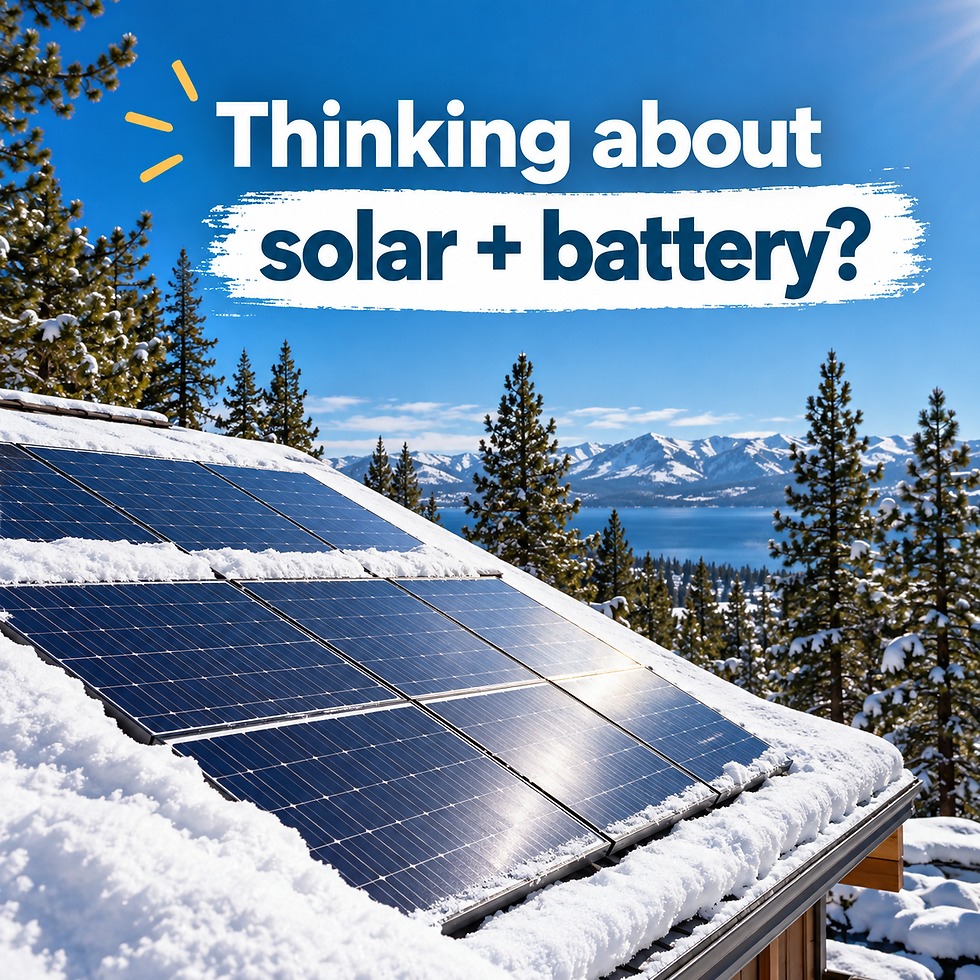
The Lake Tahoe region is different from many lower-elevation areas of California. Electricity demand can be significant during winter because of heating, ski-area operations, snow-making, and the energy requirements associated with cold Sierra Nevada weather rather than primarily from summer air conditioning.
Battery storage allows daytime solar generation to be saved and used during evening and nighttime hours when solar panels aren't producing electricity.
For Lake Tahoe solar customers, this ability to store and use more of their own solar energy can become increasingly valuable as utility rates and time-of-use structures evolve.
4. Battery Backup Provides Added Resilience in the Sierra Nevada
Power reliability is particularly important in the Lake Tahoe Basin, where residents can face wildfire risks, severe winter storms, heavy snow, fallen trees, and other conditions capable of disrupting utility service.
Battery systems can provide backup electricity during certain outages or Public Safety

Power Shutoffs.
For homes in mountain communities such as Olympic Valley, Tahoe City, Kings Beach, Carnelian Bay, Tahoe Vista, Tahoma, and Meeks Bay, having backup power can be particularly valuable for heating-related equipment, refrigeration, communications, medical needs, and other essential electrical loads.
5. Solar Supports California's Renewable Energy Goals
California's renewable-energy and greenhouse-gas goals continue to tighten. On-site solar helps Liberty and its customers move toward those targets while reducing reliance on whatever mix of resources future wholesale electricity contracts ultimately deliver.
For environmentally conscious Tahoe property owners, solar and battery storage also provide an opportunity to generate more energy locally while reducing reliance on electricity transported into the region.
6. High Liberty Electricity Rates Can Improve Solar Economics
High local retail electricity rates can make the economics of solar more attractive.
Available federal tax incentives and applicable state or local programs can further affect the cost of installing a system. Pairing solar with battery storage can also increase the amount of solar electricity a property uses directly rather than sending excess production back to the grid.
For Tahoe homeowners considering solar, however, every property needs to be evaluated individually.
Solar + storage is not free. Upfront costs, permitting, roof suitability, tree shading, snow accumulation, snow loads, system orientation, battery placement, and ongoing maintenance all matter. Not every Lake Tahoe property is an ideal solar site, and California's net-energy-metering rules continue to evolve.
That's why professional site assessments and financial modeling based on the property's actual electricity usage are essential.
Solar in South Lake Tahoe, Tahoe City, Kings Beach and the California Tahoe Basin
The challenges facing Liberty customers aren't limited to one part of Lake Tahoe.
Property owners in South Lake Tahoe, Tahoe City, Kings Beach, Olympic Valley, Carnelian Bay, Tahoe Vista, Tahoma, Meeks Bay, and surrounding California-side Tahoe communities are dealing with many of the same questions:
How much will Liberty electricity cost in the coming years? How will the NV Energy transition affect future power costs? And does it make sense to produce and store more electricity at home or at a business?
The answer will vary by property, but the combination of high Liberty Utilities electricity rates, changes in wholesale power procurement, and advances in modern battery storage makes solar worth evaluating for many California-side Lake Tahoe homes and businesses.
Solar in Lake Tahoe Requires Mountain-Specific Experience
Installing solar in Lake Tahoe isn't the same as installing a system in Sacramento or another lower-elevation California community.
Tahoe solar systems need to be designed around the realities of mountain properties. Heavy snowfall, roof snow loads, tree coverage and shading, winter solar production, freezing temperatures, wildfire conditions, roof orientation, battery location, and local permitting requirements can all influence how a solar and battery system should be designed.
A heavily wooded property in Tahoma or Meeks Bay, for example, can present very different solar conditions from a home with greater sun exposure elsewhere in the Tahoe Basin. Likewise, properties in Olympic Valley, Tahoe City, Kings Beach, or South Lake Tahoe can have different roof configurations, snow conditions, electrical loads, and backup-power requirements.
These factors make an experienced site evaluation especially important before deciding on system size, solar panel placement, or battery capacity.
Looking Ahead: Liberty Utilities Rates and Solar in Lake Tahoe
Liberty Utilities customers throughout the California side of the Lake Tahoe Basin face a period of transition: electricity rates that have already risen significantly, combined with a structural change in Liberty's wholesale power supply expected around 2027–2028.
While Liberty is working to secure reliable and affordable replacement power, the combination of existing rate pressures and uncertainty about future energy costs gives homeowners and businesses another reason to consider reducing the amount of electricity they need to purchase from the grid.
For property owners in South Lake Tahoe, Tahoe City, Kings Beach, Olympic Valley, Carnelian Bay, Tahoe Vista, Tahoma, Meeks Bay, and surrounding California-side Tahoe communities, rooftop or ground-mounted solar paired with battery storage can provide greater control over long-term electricity costs while adding valuable backup power and energy resilience.
Talk to Diamond Solar Solutions About Solar + Battery Storage in Lake Tahoe
Diamond Solar Solutions understands the unique challenges of designing solar and battery systems for homes and businesses in the Sierra Nevada and Lake Tahoe region.
From heavy snow and winter conditions to tree shading, wildfire concerns, backup-power needs, and high Liberty Utilities electricity rates, a properly designed Tahoe solar system should account for the realities of owning a home or business in the mountains.
If you're considering solar or battery storage in South Lake Tahoe, Tahoe City, Kings Beach, Olympic Valley, Carnelian Bay, Tahoe Vista, Tahoma, Meeks Bay, or another California-side Lake Tahoe community, Diamond Solar Solutions can evaluate your electricity usage, property conditions, solar potential, battery needs, and available incentives to help determine what type of system makes sense for your property. Check out our Solar in Lake Tahoe Battery & Solar Buying Guide for more information.
Contact Diamond Solar Solutions for a solar and battery evaluation and find out how much of your future Liberty Utilities electricity usage you may be able to produce and store at your own property.

Comments